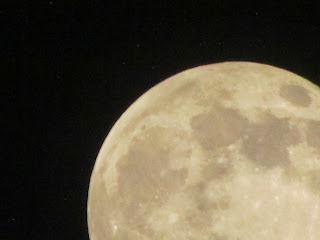
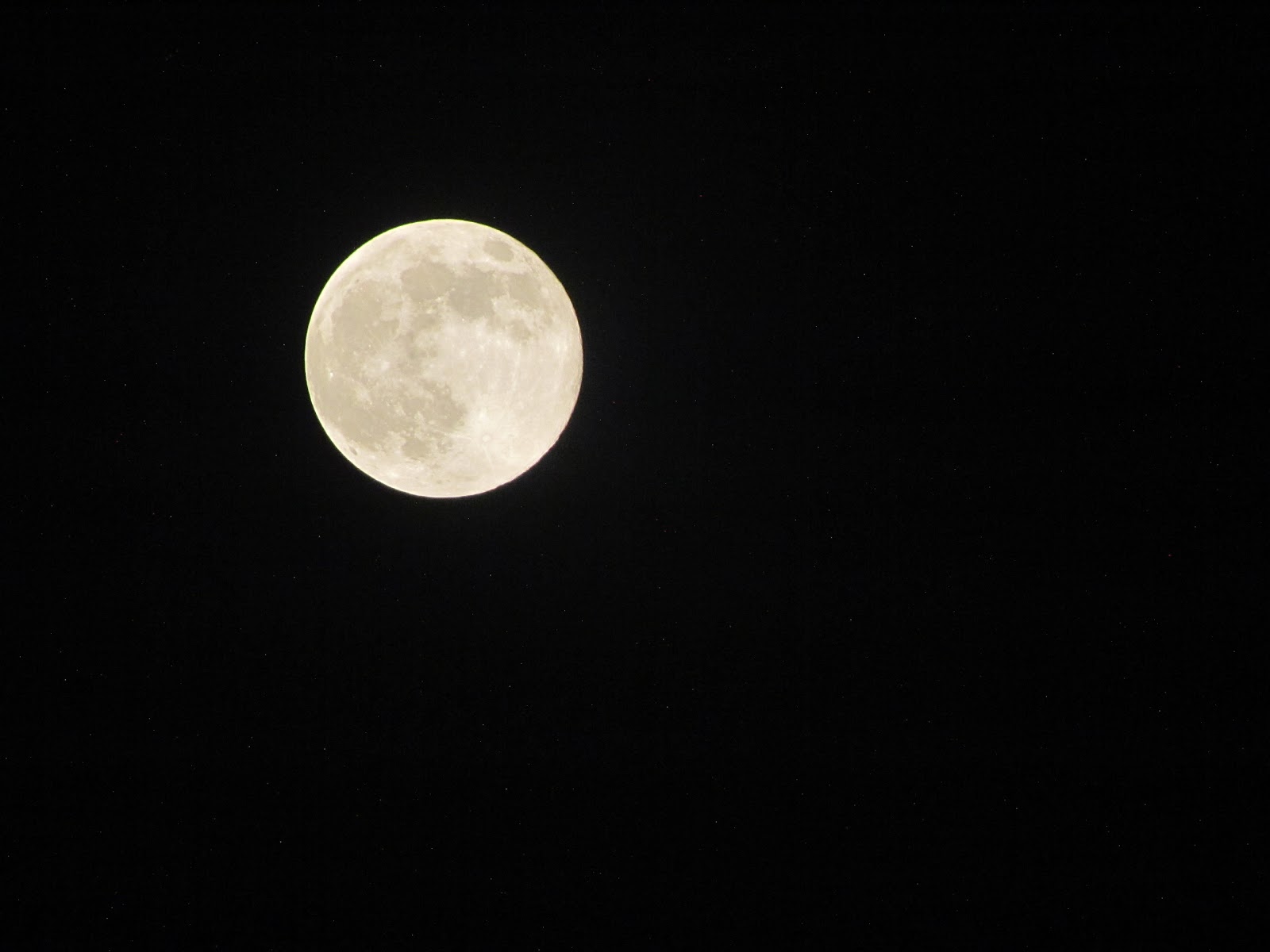
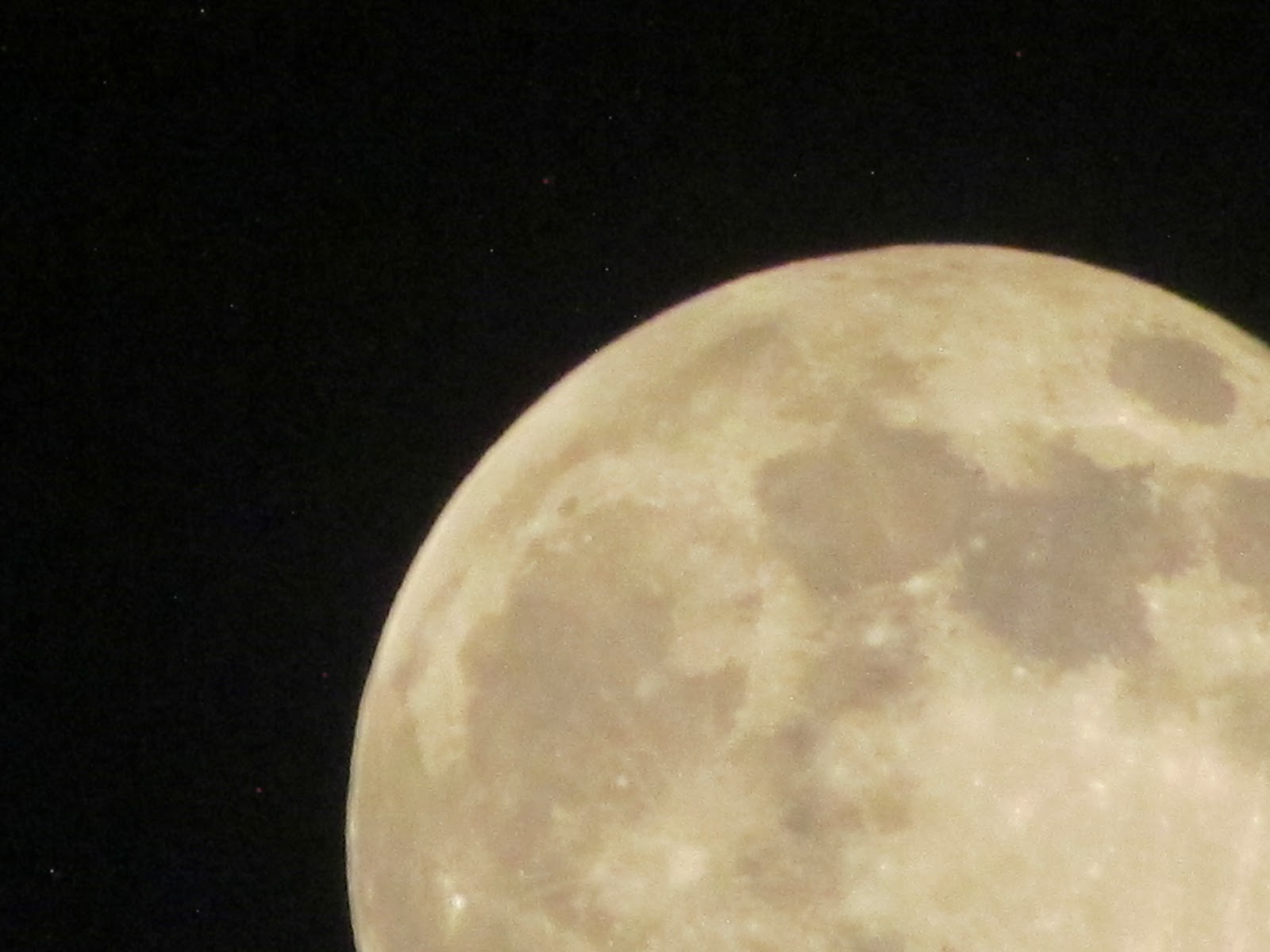
WOW!!!!! SUPERMOON PHOTOS WITH MY CANON X35

Sunday, 23 June 2013

WOW!!!!! SUPERMOON PHOTOS WITH MY CANON X35

I never thought my Canon camera was that capable of showing the oceans and burrows of moon. You will see mountains, dry- dead oceans, impacts of comets that struck the surface of moon.

for details of the event please read from

PLEASE CLICK TO ENLARGE IMAGES


http://earthsky.org/tonight/is-biggest-and-closest-full-moon-on-june-23-2013-a-supermoon#what


Most “super” supermoon of 2013 on June 22-23

    13.5K

Photo credit: Alice Popkorn   
Tonight for June 22, 2013
Planisphere - Northen Hemisphere Edition

Awesome photos of the June 2013 supermoon

Full moon falls on June 23, 2013 at 11:32 UTC (6:32 a.m. CDT in the U.S.). Thus, for many, the moon appears about as full in the June 22 evening sky as it does on the evening of June 23. This full moon is not only the closest and largest full moon of the year. It also presents the moon’s closest encounter with Earth for all of 2013. The moon will not be so close again until August, 2014. In other words, it’s not just a supermoon. It’s the closest supermoon of 2013.

At United States’ time zones, the moon will turn full on June 23 at 7:32 a.m. EDT, 6:32 a.m. CDT, 5:32 a.m. MDT and 4:32 a.m. PDT.

June 23 supermoon helps you imagine spacecraft en route to Pluto

We astronomers call this sort of close full moon a perigee full moon. The word perigee describes the moon’s closest point to Earth for a given month. Two years ago, when the closest and largest full moon fell on March 19, 2011, many used the term supermoon, which we’d never heard before. Last year, we heard this term again to describe the year’s closest full moon on May 6, 2012. Now the term supermoon is being used a lot. Last month’s full moon – May 24-25, 2013 – was also a supermoon. But the June full moon is even more super! In other words, the time of full moon falls even closer to the time of perigee, the moon’s closest point to Earth. The crest of the moon’s full phase in June 2013, and perigee, fall within an hour of each other.

What does supermoon mean exactly? And how special is the June 23, 2013 supermoon? Follow the links below to find out.

What is a supermoon?

How super is this supermoon?

How often is moon both full and closest to Earth?

Will the tides be higher than usual?

Your best photos: May 2013 supermoon

Does a supermoon have a super effect on us?

Big sun-diving Comet ISON might be spectacular in late 2013
View larger. | Astronomers say you can't really tell the difference in size between a supermoon and any other full moon. Check out this size comparison from our friend Alec Jones in the UK.

View larger. | Astronomers say it’s tough to notice the difference in size between a supermoon and any other full moon. But photographs show it. Check out this size comparison from our friend Alec Jones in the UK.
The supermoon of March 19, 2011 (right), compared to an average moon of December 20, 2010 (left). Note the size difference. Image Credit: Marco Langbroek, the Netherlands, via Wikimedia Commons.

The supermoon of March 19, 2011 (right), compared to an average moon of December 20, 2010 (left). Note the size difference. Image via Marco Langbroek, the Netherlands, via Wikimedia Commons.

What is a supermoon? The word supermoon didn’t come from astronomy. Instead, it came from astrology. Astrologer Richard Nolle of the website astropro.com takes credit for coining the term supermoon. In 1979, he defined it as:

    …a new or full moon which occurs with the moon at or near (within 90% of) its closest approach to Earth in a given orbit (perigee). In short, Earth, moon and sun are all in a line, with moon in its nearest approach to Earth.

By this definition, according to Nolle:

    There are 4-6 supermoons a year on average.

That doesn’t sound very special, does it? In fact, the June 2013 full moon lines up much more closely with perigee – the moon’s closest point to Earth – than Nolle’s original definition. According to Guy Ottewell’s Astronomical Calendar 2013, the 2013 June full moon falls only 22 minutes after the moon reaches perigee, the moon’s closest point to Earth for this month and year. At perigee, the moon lies only 356,991 kilometers (221,824 miles) away. Two weeks later, on July 7, the moon will swing out to apogee – its farthest point for the month and year – at 406,490 kilometers (252,581 miles) distant.

Day and night sides of Earth at instant of June 22-23 full moon

Day and night sides of Earth at instant of full moon (2013 June 23 at 11:32 Universal Time). In North America, the full moon is setting in the west at sunrise on June 23. From eastern Asia, it’s rising in the east at sunset. The full moon resides close to zenith – straight overhead – as seen from the Samoan islands in the central South Pacific Ocean. Image credit: Earth and Moon Viewer

How super is this supermoon? June 2013 presents the moon’s closest encounter with Earth until August 10, 2014, at which time the moon will be a scant 5 kilometers closer to Earth. The full moon will come even closer to Earth on September 28, 2015 (356,877 kilometers) and closer yet on November 14, 2016 (356,509 kilometers). November 2016 will feature the closest full moon until November 25, 2034! Maybe this helps you see that supermoons – while interesting – are fairly routine astronomical events.

Even the proximity of full moon with perigee isn’t all that rare. The extra-close moon in all of these years – 2011, 2012, 2013, 2014, 2015 and 2016 – finds the full moon taking place at or nearly the same hour as lunar perigee. More often than not, the closest perigee of the year comes on the one day of the year that the full moon and perigee most closely coincide. (See table below.)

Moon closest to Earth


Year     Date     Distance
2011     March 19     356,575 km
2012     May 6     356,955 km
2013     June 23     356,991 km
2014     August 10     356,896 km
2015     September 28     356,877 km
2016     November 14     356,509 km

How often is moon both full and closest to Earth? Closest full moons recur in cycles of 14 lunar (synodic) months, because 14 lunar months almost exactly equal 15 returns to perigee (moon’s closest point to Earth). A lunar month refers to the time period between successive full moons, a mean period of 29.53059 days. An anomalistic month refers to successive returns to perigee, a period of 27.55455 days. Hence:

14 x 29.53059 days = 413.428 days
15 x 27.55455 days = 413.318 days

This time period is equal to about 1 year, 1 month, and 18 days. The full moon and perigee will realign again on August 10, 2014, because the 14th full moon after the 2013 June 23 full moon will fall on that date.

Looking further into the future, the perigee full moon will come closer than 356,500 kilometers for the first time in the 21st century on November 25, 2034 (356,446 km). The closest full moon of the 21st century will fall on December 6, 2052 (356,425 km).

For the moon to come closer than 356,400 kilometers (221,457 miles) is quite a feat. In fact, this won’t happen at all in the 21st century (2001-2100) or the 22nd century (2101-2200). The last time the full moon perigee swung this close to Earth was on January 14, 1930 (356,397 km), and the next time won’t be till January 1, 2257 (356,371 km).

Will the tides be higher than usual? Yes, all full moons bring higher-than-usual tides, and perigee full moons bring the highest (and lowest) tides of all. Each month, on the day of the full moon, the moon, Earth and sun are aligned, with Earth in between. This line up creates wide-ranging tides, known as spring tides. High spring tides climb up especially high, and on the same day low tides plunge especially low.

Today’s extra-close full moon accentuates these monthly (full moon) spring tides all the more.

If you live along a coastline, watch for high tides caused by the June 23 perigee full moon – or supermoon – over the next several days. Will the high tides cause flooding? Probably not, unless a strong weather system moves into the coastline where you are. Still, keep an eye on the weather, because storms do have a large potential to accentuate high spring tides.

As a result, if you live near a coast, you’ll want to be on the lookout for higher-than-usual tides.

Because the moon – as always – shines opposite the sun in our sky at full moon, you’ll see the moon beaming all night tonight from dusk until dawn. This extra-close full moon is likely to usher in large tides along the ocean shorelines for the next several days, especially if these high tides are accompanied by strong onshore winds.

Bottom line: The full moon of June 22-23, 2013 is the closest and largest full moon of this year. By a new definition – one that has just entered the world of astronomy from astrology – many will call it a supermoon. There are three full moons in 2013 that meet the definition of a supermoon – May, June and July. But this June 22-23 full moon is the most super of the supermoons! A super-duper moon!

What is a supermoon?

Understanding the full moon

Each full moon has its own name. Here’s a list.

Looking for a tide almanac? EarthSky recommends . . .

Moon facts at your fingertips
Continue Reading | comments

KARTARPUR SAHIB CORRIDOR -RADIO TALK OF B.S.GORAYA

Friday, 21 June 2013

25 minute long radio talk on 

KARTARPUR SAHIB CORRIDOR

HARMAN RADIO AUSTRALIA

HARMAN RADIO TALK WITH RISHI GULATI


Continue Reading | comments

FANATICISM BIGGEST HURDLE IN THE SPREAD OF SIKHISM

Thursday, 20 June 2013

FANATICISM BIGGEST HURDLE IN THE SPREAD OF SIKHISM

 
KATTARWAD SIKHI DE PARCHAR WICH SABH TO VADDI RUKAWAT sann 2000 di gall hai. Mai apne sahure pind (Kot, Jhabal lage) si te mera veer Bicky ne dasya ke pind de bahute majhabi Christian bann gaye ney.
Mai Bicky nu lai ke ona de leader (oh nalke : hand pump laun da kamm karda si: Balkar Singh) nu bahane naal milia. Edhar odhar dian gallan to baad asi point te aa gaye.
Mai puchhya Balkar g tusi Christian keo banney. Balkar barhe maan nal bolya, "Bhaaji tusi parhey likhe lagde o chheti samajh jaoge"
Mai keha g dasso. Kehda, "Jesus ne saade vaste apni jaan kurban kar ditti; Sooli ta charh gaya. Te ki assi uhdi shahadit nu satkar den vaste christian nahi bann sakde?"
Mai andro ander tutt gaya. Mai onu keha balkar Sikh dharam wich ta shahadatan di line laggi payi aa. V, IX, X Guru sahiban dian shahadatan ginayian.
Phir mai onu dasya ke dunia da sabh to chhota shaheed Baba Fateh Singh sirf pauney 7 saal da si.
Mainu samajh ke hor vi dukh hoa onu ena shahadatan bare jara vi pata nahi si. Mainu apne aap te sharam ayi. Mai apne aap nu lahnat payi te ona kattarvadian nu jehre Sikhi de phelaa wich sabh to
vaddi rukawat ney. Eh 5 lakh da langar ta la sakde ne par Guru Nanak patshah te 5 Rs. da tract nahi vand sakde. Eh 2 Rs da Japuji da gutka nahi vand sakde. Ajj Sikhi de parchar wich sabh to waddi rukawatt such jhooth nu mannan valea di aa.
Brahmani Deredaaran ne Sikhi agwah kar lai aa.
Continue Reading | comments (1)

LACHHMAN SINGH GILL SON OF PUNJABI LANGUAGE

LACHHMAN SINGH GILL THE TRUE SON OF PUNJABI LANGUAGE 


The Iion son of Mysore Tipu Sultan said, "lf one is to live, he should live like a lion, living a 100 long years like a sheep issueless," S. Lachhamn Singh Gill lived short but really like a lion. ln just a tenure of 9 months as Chief Minister of the Punjab he did something which charismatic leaders can't do in years. Gill made Punjabi language the Queen at a time when many of its own sons were feeling ashamed of its accession,  Gill has thus carved out a niche in the history of this deprived language. We, reproduce an article by l.S. RAZ written sometimes ago.
After the dawn of independence a towering personality appeared on the political scene of Punjab. Without mentioning him, the post independence history would remain unauthentic and incomplete. This was Late Lachhman Singh Gill who during his stormy and brief regime, not only gave our mother tongue, Punjabi its due place but also boosted the morale of bureaucracy.
The whole story is still remembered by those who knew Gill and were his friends. It happened that Punjab made a tremendous progress in the industrial  as well as agricultural sector under the able guidance of Kairon. While Partap Singh Kairon succeeded on all fronts with his keen sense of observation and extensive knowledge of Punjab affairs and its people, all his efforts to solve the language problem of the state did not mature as the majority of Hindus were not prepared to accept Punjabi  as the official language of the State, The Hindus and the Sikhs were so divided on the issue that it became a constant headache for the centre.
 Unfortunately, even after the formation of Punjabi Suba, the Hindi Punjabi controversy remained unresolved as before.
It is a well known fact that Gill was instrumental in bringing late Sant Fateh Singh in the political field with the result that the prominent Akali Leader Master Tara Singh suddenly went into oblivion. During the last days of his life he was repenting on this, especially when after the formation of Punjabi Suba Sant Fateh Singh let him down by nominating Justice Gurnam Singh a new entrant in Sikh politics, as the leader of the Akali Legislature Party. Disgusted with the attitude of the Sant, Gill raised hell with the party high command and revolted against Justice Gurnam Singh which led to the fall of the Ministry headed by Justice Gurnam Singh. Then Lachhman Singh Gill became the leader of the Akali Legistlature Party and consequently the Chief Minister of Punjab.
Within a month of his taking over an official language Act was passed 'declaring Punjabi as official language of the State', and Hindi to continue as a link language between the Centre and the Punjab State. Just a week before the Baisakhi of April, 1969, he light heartedly told his friends that on the auspicious occasion of the Birthday of Khalsa, the illiterate persons in Punjab would become literate.
This is what exactly happened on the Baisakhi day when English typewriters were replaced by the Punjabi typewriters and all the officials were bound to learn the language of the State in right earnest. This set at rest the long standing friction created between the two sister communities by the ticklish problem of the State language. Thus the credit  for  giving rightful status to Punjabi Language exclusively goes to this dynamic leader of Punjab. Frankly speaking, his achievements in the field of link roads and rural development recede into the background before his historic achievement of making Punjabi as official language of the State, Punjab will remain ever indebted to him for all times to come.
This great son of Punjab was born in 1914 in a Jat Sikh family in village Chuhrchak in District Ferozepur (now District Faridkot). This village was the stronghold of revolutionaries. Lachhman Singh Gill was brought up in an atmosphere of revolution which later on turned him into a patriotic nationalist to the core.
Before independence, he was jailed twice for his anti British activities. To him also goes the credit of saving the lives of hundreds of Muslims who were victims of communal frenzy followed after the partition in 1947.
For sometime, he remained President of Post and Telegraph Union of Delhi unit. This gave him the opportunity of entering into close contact with Jaya Prakash Narayan who was the Chief Patron of All lndia Union of Post and Telegraph.
With the decline of Socialist Party, Lachhman Singh Gill, feeling the pulse of 'Panth', joined the Akali Dal and remained its front ranking leader till his death.
Although the period of his stewardship was much brief, only nine months, his achievements were second to none including Partap Singh Kairon who ruled the State for as many as eight years.
On the top of it all, Lachhman Singh Gill was a friend of friends and did not get drunk with the wine of power  a rare trait nowadays. His untimely death removed from the Punjab's political scene a man who lived and died for 'Punjab, Punjabi and Punjabiat'.
Thus Gill with his short stint as Chief Minister of Punjab has created an honourable place in its golden history.
Continue Reading | comments

HUKAMNAMA ON TATTOOING

Wednesday, 19 June 2013

WITHOUT ANY DISCUSSION IN THE SANGAT THE JATHEDAR’S EDICT ON TATTOOING ISSUED UNDER PRESSURE 

Giani Gurbachan Singh Jathedar
Sri Akal Takhat Sahib
ਲਗਦੈ ਟੈਟੂ ਬਣਾਉਣ ਬਾਰੇ ਹੁਕਮਨਾਮਾ ਜਾਰੀ ਹੋਣ ਪਿਛੇ ਆਰ ਐਸ ਐਸ ਦਾ ਹੱਥ ਹੈ। ਓਨਾਂ ਦਾ ਮੰਤਵ ਕਿਸੇ ਤਰਾਂ ਅਕਾਲ ਤਖਤ ਦੀ ਤਾਕਤ ਨੂੰ ਹੌਲੀ ਹੌਲੀ ਖਤਮ ਕਰਨਾ ਹੈ। ਜਥੇਦਾਰ ਹੁਕਮਨਾਮਾ ਸਿਰਫ ਓਥੇ ਜਾਰੀ ਕਰ ਸਕਦੇ ਜਿਥੇ ਸੰਗਤ ਵਿਚ ਬਹਿਸ ਹੋਈ ਹੋਵੇ। ਹੁਕਮਨਾਮਾ ਗੁਰੂ ਪਾਤਸ਼ਾਹ ਦੇ ਬਖਸ਼ੇ ਗੁਰਮੱਤੇ ਦੇ ਸਿਧਾਂਤ ਤਹਿਤ ਜਾਰੀ ਹੁੰਦਾ ਹੈ। ਰੁਮਾਲਿਆਂ ਤੇ ਗੁਰਬਾਣੀ ਦੀ ਮਨਾਹੀ ਤੇ ਦਿਲੀ ਦੀ ਬੀਬੀ ਨਿਰਪ੍ਰੀਤ ਕੌਰ ਦਾ ਵਰਤ ਤੁੜਵਾਉਣ ਪਿਛੇ ਵੀ ਸਿਆਸੀ ਤਾਕਤਾਂ ਦੀ ਅਕਾਲ ਤਖਤ ਦੇ ਕੰਮ ਵਿਚ ਦਖਲ ਅੰਦਾਜ਼ੀ ਹੈ। ਜਰੂਰਤ ਹੈ ਜਥੇਦਾਰ ਗੁਰਦੇ ਵਾਲਾ ਬੰਦਾ ਹੋਵੇ। ਸਾਰੀ ਗਲ ਵਿਸਥਾਰ ਵਿਚ ਪੜੋ ਅੰਗਰੇਜੀ ਵਿਚ ਜੀ।

ਹਰਿ ਕਾ ਨਾਮੁ ਲਿਖਿ ਲੀਓ ਸਰੀਰ ॥੧॥  {ਪੰਨਾ 524}


Sikhism is a faith of Sangat and Guru. Guru repeatedly declared that Sangat is above him the Guru, so much so even the Tenth Emperor got himself baptized at the hands of Panj Pyaras. To prevent internal dissensions Guru gave the concept of Gurmata the resolution. Keeping in view the issue, Gurmata can be moved locally, for a region and for the entire nation.
 The concept of eternal seat the Akal Takhat is thus in continuation of Gurmata principle. Akal Takhat head or jathedar is thus the authority to get an issue of national importance resolved. The Akal Takhat is the thus the collective conscience of Sangat the congregation.
Jathedar is thus a sort of president in an assembly; in this case the general body of the Sikh masses. His job is thus to know the conscience of the Sikh masses. But  then again he himself alone is no body. He has to convene the Panj Pyara meeting and then pass a gurmata for the Sikh nation.  To make more clear an issue in question is first deliberated in the sangat. After a reasonable discussion a consensus naturally occurs and the Jathedar thus promulgates hukamnama the edict to set at rest the discussion. So you can say he has to be the rubber stamp of Sikh Sangat.
Thus without consensus the Jathedar is an ordinary Sikh.
It has been the endeavour of Khalsa Panth to appoint such persons as Jathedar who are not self seeking persons. He has to be a low profile person and not a kind of ambitious person. Some kind of saintly figure.
Keeping in view the powers of Jathedar naturally no Govt would allow Govt within the Govt. The Akal Takhat had thus remained an eye sore for the Govt of Delhi. The endeavour of the Govts has thus been to manipulate appointment of  the jathedar of their likings and to misuse his authority. It is said the first such Jathedar to be appointed was Ragi Darshan Singh.
The worst was Giani Pooran Singh who would issue hukamnama the edict every now and then at his whim and fancy. Later how ever it was proved that Giani was a tool in the hands of RSS.
Keeping in view the intensions of the Govt of India and RSS, we can only expect that the Sikh Diaspora would act as pressure group for Jathedar so that he can’t bow to the dictates of Delhi, RSS and Badals. But unfortunately the performance of Diaspora has so far been hopeless.
I am pained when I feel that my nation’s Jathedar has erred under some pressure. Recently the Jathedar was used to terminate the hunger strike of Bibi Nirpreet Kaur of Delhi. One can question the conduct of Jathedar in this, where was the consensus in this case? Where was the Gurmata the resolution. Sikh Diaspora should have questioned him. Similarly he issued edict against writing of gurbani on Rumalas.
I remember once Joginder Singh Vedanti was used to issue a hukamnama that no new Gurdwara be established.  The people should have questioned him if not a gurdwara should we construct a temple. But none questioned him.
Why I am writing all this is that I am pained at the recent hukamnama of the jathedar on tattooing. (Well, so far as the issue of compliance of the order is concerned I will comply)
I feel the edict of the jathedar must have been issued under pressure from vested interests and I believe it is not in order in view of the following:-
1.    That no discussion in the sangat took place as to use of Gurbani in tattooing.
2.    That there is a need to change outlook. Because the Guru says God or His concept is daily fresh. (Sahib mera neet nava) Earlier Gurbani was written on paper (or may be cloth, wood or iron) but now it is available on computers, chips, cds, dvds. The computer has negative or sex oriented things also stored in it. But that doesn’t mean that Gurbani is desecrated. The respect about the Gurbani is in the mind of the user. Gurbani is a concept which can’t be desecrated unless some one willingly or deliberately does so as in the case of Piara Bhaniara. Thus if some one tattoos  Ikonkar or Khanda on his body it is no desecration or disrespect. It is rather respect or preaching.
3.    Also we have been seeing our gianis with tattoos of ‘Ikonkar’ on their hands.
4.    Also the Gurbani basically stresses on love and tolerance. There is no room for fanaticism. Fanaticism has been harming Sikhism.
5.    Even the Guru also wished that his mind was branded with the naam the name of God.  ਰਾਮ ਹਮ ਸਤਿਗੁਰ ਲਾਲੇ ਕਾਂਢੇ ॥1॥ ਰਹਾਉ ॥ ਹਮਰੈ ਮਸਤਕਿ ਦਾਗੁ ਦਗਾਨਾ ਹਮ ਕਰਜ ਗੁਰੂ ਬਹੁ ਸਾਢੇ ॥ (page 171 SGGS) O God, I am the slave of the True Guru.  || 1 ||  Pause  ||   My forehead has been branded with His brand; I owe such a great debt to the Guru. He has been so generous and kind to me.
In light of above I request that the jathedar may kindly avoid indulging into such small things without the deliberation of issue in the Sangat. I feel the Jathedar might have issued the hukamnana under the pressure from vested interests. So that the concept of Hukamnama is harmed.
+++++++++++

http://timesofindia.indiatimes.com/india/Clergy-isolated-on-legal-action-for-tattoos-on-Gurbani-verses/articleshow/20657165.cms

Clergy isolated on legal action for tattoos on Gurbani verses

Yudhvir Rana & IP Singh, TNN | Jun 19, 2013, 04.16 AM IST

AMRITSAR/JALANDHAR: Various Sikh intellectuals and historians have expressed differences with Akal Takhtj athedar Giani Gurbachan Singh over pursuing legal action against those who tattoo Gurbani verses and even EkOnkar (first words in Guru Granth Sahib) on their body.
According to Gurtej Singh, an author and former professor of Sikhism, it's nothing but a diktat. "Sikh clergy has no business issuing such directions. If one does not have any intention of insulting Gurbani and is getting Ek Onkar tattooed out of devotion, how can the action be termed as 'maliciously hurting religious sentiments', as defined in Section 295A of IPC," he said.
"The clergy cannot have such intimate control on the body and minds of Sikhs. It is something between a person and guru or God and ones own convictions. How can they go to such an extent and do things which are not even in their domain. They are issuing fatwas (edicts) on all that is wrong and against Sikh tenets, in which Sikh Sangat is supreme and not any clergyman," he added.
B S Goraya, founder of Gurdwara Kartarpur Sahib Langha Movement, said etching Ek Onkar on hand was an age old practice and didn't mean any disrespect to Gurbani. The jathedar should have held Panthic deliberations on the issue, he said. "It is a wrong decision and lacks panthic opinion," said Goraya.
On Monday, the jathedar had announced decision to recommend filing of FIR under Section 295A of IPC against persons tattooing verses of Gurbani or Ek Onkar on their body.
Professor Balwant Singh, who is a senior professor at Guru Nanak Dev University and member of several committees constituted by Shiromani Gurdwara Parbandhak Committee and Akal Takht, opined that there should have been comprehensive guidelines on the issue to dispel confusion. He said the jathedar should have spoken about the extent of limitations to which Gurbani verses can be printed or written.

"Today we see Gurbani verses and Ek Onkar in print media, invitation cards, visiting cards, and decorative calligraphy among others. The Sikh clergy should also give guidelines on these," he said and added that every effort must be made to maintain the honour and respect of Sri Guru Granth Sahib.

According to Jalandhar-based advocate Navtej Singh Monhas, intent is always the foremost point for registration of a criminal case. "From where does this criminal or malicious intent come if somebody is getting a tattoo out of love for God or Guru? The clergy is pushing the Sikhs back in the Stone Age. At most, they can issue an advisory on such issues," he said.
He also pointed out that several elderly Sikhs and prominent community leaders, including those from SGPC and SAD, had Ek Onkar inscribed on their hand or forearm.
The clergy's decision has not gone down well even with young radicals. President of Sikh Youth of Punjab, which owes allegiance to radical organization Dal Khalsa, Ranbir Singh said the clergy could have issued a well-reasoned advisory. "To threaten the youth, that too with legal action while giving up their own authority will push them further away from religion," he said.
Meanwhile, in what can be seen as an admission of the eroding authority of Sikh clergy in getting its directives implemented, the Akal Takht jathedar admitted on Tuesday that he was resorting to legal action as people had less care about religious punishment. "If they are not afraid of legal action or going to jail, they don't care much and think they'll go scotfree after tendering an apology," he claimed.
"We are ready to contemplate further on the issue and will do so when such matters are brought into our knowledge," he added.
++++++++


No to Sikh religious tattoos


Jathedars impose ban on religious tattoos like Ek Onkar, Khanda

Legal action under Section 295-A for engraving religious tattoos

Amritsar, June 18: If you are planning to engrave any Sikh religious symbol on your body, then drop your idea right away, anyways a legal action can be initiated against you. In the recent meeting of the Jathedar of five Sikh Takhts, a decision was taken that if someone would engrave religious symbols like ‘Ek Onkar’ or ‘ Khanda’ on their body parts as a tattoo, then a legal action under Section 295 A will be initiated against that person....

Continue Reading | comments (1)

1 THE ONE

Saturday, 15 June 2013

1 THE ONE


Infinite is the expansion of universe. But that 1 (one)  pervades in all. The way digit 1 permeates in all. There is no number which does not contain 1. Like, when 1 joins 3 times the figures becomes 3 and 7 contains 7 ones. So multiply 1 with any digit, it keeps expanding, there is no concept of ‘nothingness’. When there is nothing there is no God.  Divide it by any number it won’t be zero 0. So God permeates exactly like this. 1 is the best example to explain God. Guru Nanak our True Emperor blessed us by giving the most appropriate explanation of God by prefixing 1 before Om and then drew a line to show the expansion to make it omkar the expanded to make it perfect representation of God almighty: IK ONKAAR. Do u want to feel that that invisible God then come to the lap of Guru Nanak’s Japuji. U will feel the expansion the infinity the endless One.  U will know that the rest of universe is very much like u. Ur hatred will thus vanish. U will tend to love others. So men come. Come if u want to play the game of LOVE. Love to all.


Continue Reading | comments

FEDERAL INDIA

COALITIONS IN THE CENTRE - INDIA HEADING TOWARDS FEDERALISM


The early man was settled in tribal groups where the fittest man was its head and ruler. There were inter-tribal conflicts, wars and invasions with the motive of plundering the property of the weak groups. This type of tribal governments were even there when Alexander invaded India some 2300 years ago. These tribal governments often collaborated with the neighbouring tribes for their mutual security and this collaboration is called federation which is considered by the political scientists as an ideal form of governance. 

1947 ਵੇਲੇ ਕੋਈ ਅਜਾਦੀ ਵਜਾਦੀ ਨਹੀ ਸੀ ਆਈ। ਸਿਰਫ ਹਕੂਮਤ ਬਦਲੀ (ਟਰਾਂਸਫਰ) ਸੀ। ਏਥੇ ਅੱਜ ਸਹੀ ਲੋਕਤੰਤਰ ਨਹੀ, ਠਗਣਾ ਲੋਕਤੰਤਰ ਹੈ। ਅਸਲੀ ਲੋਕਤੰਤਰ ਉਹ ਹੁੰਦਾ ਹੈ ਜਿਥੇ ਹਕੂਮਤ ਲੋਕਾਂ ਦੀ ਹੋਵੇ। ਪਰ ਭਾਰਤ ਵਿਚ ਤਾਂ ਹਕੂਮਤ ਦਿੱਲੀ ‘ਚ ਚੰਦ ਬੰਦਿਆਂ ਦੀ ਏ। ਭਾਰਤ ਵਿਚ ਪੰਚਾਇਤਾਂ, ਮੁਨਿਸਪਾਲਟੀਆਂ ਕੋਲ ਅਸਲੀ ਤਾਕਤ ਨਹੀ ਹੈ। ਹੋਰ ਤੇ ਹੋਰ ਸੂਬੇ ਵੀ ਤਾਕਤ ਪੱਖੋ ਖੋਖਲੇ ਨੇ। ਹਾਂ ਸੂਬਿਆਂ ਨੂੰ ਪੁਲਿਸ ਜਰੂਰ ਦੇ ਰੱਖੀ ਹੈ ਤਾਂ ਕਿ ਭਰਮ ਭਾਅ ਬਣਿਆਂ ਰਹੇ। ਅਸਲੀ (ਅੰਗਰੇਜ ਵਾਲੀ) ਤਾਕਤ ਕੇਂਦਰ ਕੋਲ ਹੈ। ਹਾਸੇ ਵਾਲੀ ਗਲ ਤੁਹਾਨੂੰ ਦਸੀਏ ਕਿ ਅਮਰੀਕਾ ਦੀ ਕਿਸੇ ਮੁਨਿਸਪਾਲਿਟੀ ਕੋਲ ਜਿੰਨੀ ਤਾਕਤ ਹੈ ਪੰਜਾਬ ਸਰਕਾਰ ਕੋਲ ਓਨੀ ਵੀ ਨਹੀ। ਅਕਾਲੀ ਐਵੇ ਸੁੱਕੀਆਂ ਕੱਛਾਂ ਮਾਰਦੇ ਰਹਿੰਦੇ ਨੇ।ਪ੍ਰੋਫੈਸਰ ਰਸ਼ੀਦਉਦੀਨ ਖਾਂ ਨੇ ਕਿਤਾਬ ਲਿਖੀ ਸੀ (ਫੈਡਰਲ ਇੰਡੀਆ)  ਕਿ ਜੇ ਭਾਰਤ ਨੇ ਸੱਚ ਮੁੱਚ ਲੋਕਾਂ ਦੇ ਹੱਥ ਤਾਕਤ ਦੇਣੀ ਹੈ ਤਾਂ ਇਥੇ ਸੰਘੀ ਰਾਜ ਹੋਵੇ ਭਾਵ ਇਕਾਈਆਂ ਤਾਕਤਵਰ ਹੋਣ ਸੂਬੇ ਤਾਕਤਵਰ ਹੋਣ। ਕੇਂਦਰ ਕੋਲ ਸਿਰਫ ਫੌਜ, ਵਿਦੇਸ਼ ਮਾਮਲੇ, ਕਰੰਸੀ ਤੇ ਸੰਚਾਰ ਦੇ ਮਹਿਕਮੇ ਹੀ ਹੋਣ। ਅਸਾਂ ਉਸ ਦੀ ਕਿਤਾਬ ਦੇ ਅਧਾਰ ਤੇ ਇਹ ਅੰਗਰੇਜੀ ਵਿਚ ਲੇਖ 1998 ਵਿਚ ਲਿਖਿਆ ਸੀ। 

It was the earnest desire of the founding fathers of the Indian Constitution that the country would become a real republic i.e the governance by people themselves. Accordingly the founders gave certain guidelines to the future rulers of the independent India in the form of Directive Principles of State policy. They wished that the real power be transferred to the people themselves through the Panchayat or other local bodies. It is 50 years since India became independent now and the rulers have not moved an inch in this direction. The result is, more and more people are getting disgusted with the rule. Its reflection can be seen in the form of unrest in North-Eastern states, in Gorkhaland, the Caste wars, Uttrakhand, Jharkhand, Khalistan, Jammu and Kashmir, Babri retaliations, Tamils, Shiv Senas, Naxalism etc. The fact is today there is more violence against Delhi than it was before 1947 against the British. Its only reason is that the power has not been transferred to the local level. Governance is becoming more and more centralised and where ever and whenever people raised their voice for more powers these were termed by the rulers as secessionist overtones.
Those whose fathers and grand fathers fought the battle of independence are worried of its sustenance and preservation. Since the Congress which has virtually ruled the State for about half a century never paid any serious attention to the cries from the periphery. It always tried to harp on the subjects which were constitutionally under the jurisdiction of the States. As a result of which people have started preferring regional parties. Political analysts now agree that in future there would never be the single party rule in the centre, of course except in cases where the party or parties project popular personalities like film stars or some  other emotionally appealing personality. ln past two three occasions we have seen how government formation has been a difficult task but good sense prevailed and we found the coalition governments at the Centre. Now again if the Sonia/ Priyanka factor did not work, we will again have the same situation. If something is not done well in time we may witness some hung partiament resulting into a serious deadlock and elections again. But is it certain that even after elections people will return single parly?
The present government is perhaps a record where 13 regional parties joined hands together to form the government. The return of regional parties is a clear indication what the people want. If this country is to survive it will have to allow greater say to the states, and eventually pass on the power to the local bodies. It is an accepted fact that India is a canglomerate of various nations put together, so much so even the Chairman of the constituent Assembly Dr. Rajinder Prasad also admitted it. It is however different that the Assembly in spite of this fact, gave a highly centripetal constitution to India. Scholars agree that it was because of the Pakistan factor that they ignored the federal model of the government. They felt if the Muslim factor can keep many nationalities together under the Pakistani why not a unitary India where again people were bound with a religious factor. The pakistan experiment however could not last long and in 1971 one nation pulled out from it. We surely want that it should not happen to India and if it is to be kept intact, it will have to pass on the power to the people themselves. Religion always is not a sole factor to keep the countries united. Had it been that USSR would not have split or there would not have been many countries in the Middle East where again the religion is common lslam and Europe where the religion is predominantly Christianity.
Ideally it is the nations that voluntarily come together to form federations for reasons of security and trade. For example Switzerland Confederation was formed some 700 years ago when its units were threatened and it has survived for so long now. There are interesting examples when States would voluntarily come under the umbrella of a larger Nation for security reasons and  there are several examples in the Indian history itself. But only such federations have survived the test of time where the federations allowed greater autonomy to  its constituents.
 In India whosoever raised this voice was dubbed as the secessionist and rejected. The Akali agitation of the early Eighties is a glaring example. The Centre instead of loosening its hold on certain subjects rather tightened it further with the result the principle of governance by the people was further betrayed.
Today the States have less subjects in their list as compared with a local body in the US. The whole system is harshly disposed towards the states. Whatever amount of majority a party might have in the State Assembly the Centre has vast powers to dismiss the Provincial Government if it does not like it. It is not only in principle but the Centre has done it on several occasions. It dismissed the Telgu Desam Government of NTR, CPI (M) Government of Namboodripad. In fact there is a long list of such dismissals where the Centre engineered defections for the formation of governments of its own liking. Even if a State Assembly is allowed to complete its term it has very little to do in view of its limited jurisdiction and funds.
Today the Centre has a long list of 144 subjects to legislate upon (Union-97 and Concurrent-47) while the States have only a list of 66 items only, plus the Centre has residuary powers with it. Also there is a Veto in the hand of President in the case of an assembly bill. Except money bills the President can return the bill otherwise passed by the State Assembly. Major part of the taxation is with the Centre and there "no", defined law as to sharing of the taxes ' and the allocations are purely at the whim and fancy of the Centre. Also India has a unified Civil Services and all the officers like those IAS and IPS are recruited by the Centre and it imposes service restrictions as to the All India  Services Iike the Governor in the state capital its agents in the shape of IAS and IPS officers are watching the whole performance of the state government and obviously reporting to the Centre. Plus the centre has authority to impose the Emergency like it did in 1975 and suspend the Fundamental Rights. It has also the authority to impose Emergency in a particular State instead of whole of India. The Planning Commission again is not a statutory body and is under the direct control of the Cabinet. 'All this shows that India is a highly centralised democracy or the unitary system while a Republic has to be essentially a federal structure.
 Even otherwise also India has never been politically one as it is today. On, no occasion in history it was so much centralised as it is today, except for short period like the British rule of 1857 to 1947, or during the rules of Emperor Ashoka (D. 2328C) Sultan Allauddin  Khalji (D. 1316 AD) and Aurangzeb (D. 1707 AD) lt is also noteworthy that the South was never the part of India during the above Islamic rules. Even during the British Raj the local element was comparatively stronger. So much so there were 356 Princely States at the time of independence. The Ancient India was also regionally organised into the 'Janpaddas'. Vedas and Puranas have references to the existence of such Janpadas or the tribal territories. Vayu Purana gives a detailed account of 165 'Janapadas of Bharatvarsha'. Those 165 Janpadas were constituted under seven major regions or the greater provinces like the 1. Udichya -Eastern, 2.North Western region, 3.Madhya Desha-Central region, 4.Apparanta-Western region, 5.Prachya -Eastern, 6.Dakshinapatha Southern, 7.Vindhyan and the 8.Mountain region. In that ancient India even Afghanistan was part of the Greater India what to talk of Bangla Desh and Pakistan. The janapadas were all Republics in themselves yet there was interaction between them. It was perhaps a perfect model of the federal system.
Just for the amusement of our readers some of the janapads of North and western regions were : Kekays, Shudra, Sindhu, Vahlika, Harpurika, Sakadriha. Madarika, Gandhara, Yavana etc. Interestingly those divisions were based on some logic or some common sense.
Even the Indian administration has acknowledged it that the smaller States are better manageable and its managers often cite the case of Haryana. Ironically the Indian Union which is highly centralised is even larger than more than 170 countries of the world with its 15th position-on the Globe. Except China and perhaps Russia rest of the States which are larger than India have the federal 'type of set-up. India which has 25 States and 6 Union Territories out of which 12 of its States or provinces are even larger than 100 Sovereign countries of the world. Uttar Pardesh with a population of 112 million is even bigger than Bangladesh (103.2 million) and Pakistan (100 million) which themselves are the seventh and eighth largest states of the worid. Similarly the position of Bihar (70 million), Maharashtra (63 million), Andhra Pradesh (54 million), Tamilnadu (49 million), have population individually egual to some. of the larger countries of. the world, like ltaly-57 million, U.K-57, France-55, Phillipines-57, Thailand-53,, Egypt-50, lran-45. Turkey-S1 Canada 26,. Thus India should have atleast 200 provinces if 'the country is to be administred properly and if it is to be formed a true Republic for example those 425 districts of India which are presently the administrative and control units of thd Centre and the Sta{es shoulci be.turnddintd some sorl of locit Sdtf governments with much of the planning decentralised.
janapadas in ancient india from Rashiduddin's Federal India: A design for change


An eminent professor Rasheeduddin Khan who is Internationally reputed and was twice nominated to Rajya Sabha and represented India in the UN General Assembly (1969) and a member of ICSSR, after a thorough study of the, Indian social pattern noted that, "India is thus a continental polity constituted into a single territorial sovereignty. These diversities in India based on religion and caste, language and dialects, cultural patterns, regional pulls etc. are as big in their physical distribution and dimensions as also in their distinctiveness as are normally the hallmark of separate nations. "Prof. Rasheeduddin who attributes the cause of too much centralised India to the urgent urge for national unity underlined by the trauma of partition of the country and says that it was because of this reason that there is too much of bias in favour of greater centralisation of power and thus larger jurisdiction to the Centre. The Professor feels that historically it was the Transfer of Power and not essentially a complete independence to form a Republic. Writes he," Historically the Government of India is the successor of the highly centralised and authoritarian Viceregal Govt. Whose grandeur of power was a match to "the much cited Czarist autocracy of imperial Russia." On the day of Independence the highly powerful Centre was transferred to the Congress. He says,"We should remember that the constitution of India is not a basic agreement between federating units that were previously independent in status but on the contrary a fundamentally made and enforced by a central authority, in the name of people which alone had created the units. To i remedy the rot and to save tfris great country from chaos Prof. Khan has enlisted some of the radical suggestions mooted by some political parties and individuals for immediate consideration:
1.    Constitution be amended so that the residuary powers are with the States instead of the Centre (article 248)
2.    Article 249 be deleted which gives the power to parliament to legislate on the subjects which are on the states list.
3.    Provision of 75% of total revenue to the states. (article-280)
4.     Delete article 302 which empowers parliament to impose restrictions on trade and commerce with a state or, between the states.
5.    Delete articles 356 and 357 the  emergency provisions giving right to the Centre to dissolve a Assembly and impose Presidential rule.
6.    Delete article 360 which empowers the President to interfere in a state administration  on grounds of threat of financial emergency.
7.    Delete article 200 and 201 which empowers the Governor to withhold the assent to bill.
8.    Amend article 3 to ensure that the name and area of state cannot be, changed without the consent of the State Assembly.
9.     Article 370 be not touched and, the demand of BJP and its allies be ignored.
10.    Article 368 be amended so that no amendment to the Constitution is possible without 2/3 majority.
The above suggestions are of course in addition to the recommendations of the Sarkaria Commission. Prof khan has also enlisted some 6 more, proposals as under:
1.     The centre should retain only such portfolio as Defence, Foreign Affairs, Foreign Trade, Currency, Communications, etc.
2.    The States should be adequately represented on the National Development Council,(NDC)
3.    The NDC and Planning Commission should have statutory powers.
4.    All India services like the IAS, lFS, IPS etc. be abolished and only the Union services and the State services should exist.' Further Centre should not have any, jurisdiction over the personal of state governments.
5.    Seventh schedule and the three lists should be suitably amended to give greater autonomy to states.
6.    To ensure the basic federal principle of equality, federating states should have equal representation to Rajya Sabha (and Lok Sabha also) however there could be exception to States and territories with very small population.
7.    Before this, however the following issues and suggestions should also be considered;
 (i) Territorial reorganisation of states on the criterian of providing to states maximum homogeneity within and maximum identity without   on the five principles of
(a) Socio-cultural affinity in terms of language, dialects, beliefs, religious communities and historical memories,
(b) Ethnic similarity, caste, tribe etc,
(c) Administrative manageability in terms of economy and population,
 (d) Distinct patterns of economy,
(e) Size of the State commensurate. with the need for closer contact between the voters and their representatives. In brief the main concern should be to create States which are socioculturally, homogeneous and administratively and politically manageable. ..
 (ii),Activation bf the Punchayati Raj and Nagarpalika system with necessary devolution of authority to build active grass-roots democracy.


Continue Reading | comments

GREY HAIR

GREY HAIR - SNOW ON THE ROOF DOESN'T MEAN THERE IS NOT FIRE IN THE FURNACE
by Lowel Ponte


Continue Reading | comments

JATTS

JATTS - A REBEL RACE RISES FROM SHUDRA TO SUPREMACY

Jatts or Jats a caste (or a race) of North India and Pakistan was originally bracketed into the Shudra category of Brahmin. However with their uprightness they raised their status in social hierarchy. In Sikhism their status is even above the Brahmins. In this article we read their interesting traits.


Continue Reading | comments

WAGAH FENCE TO VANISH

Friday, 14 June 2013

"WAGAH FENCE BOUND TO VANISH IN 10 YEARS" so said a Swedish Scholar 15 years ago


State's hold on trade, commerce and economy stands  rejected through the demise of USSR. The lndian experiment  of protected entrepreneurship has collapsed as is evident from  the disinvestment policy of the government. Open international  trade has got such a boost that many European countries have  practically openend their borders. Multinational companies are  moving in everywhere and their slogan is "Peace is good for  business". Obviously they do not invest in such regions where  peace is threatened and indirectly work as a pressure group  on any nation for maintenance of peace.  An interesting factor has however emerged in the west,  i.e. the consumption has reached a saturation point and whatever amount of advertising, it has failed to generate demand.  The western companies are obviously looking for markets where  they can sell theii products. They see lndian sub-continent has  a big potential for their products.  Economic zones are fast developing like ECM and  ASEAN etc. and they have banned further entries. lf the  nations of the sub-continent are to survive economically they  will have to come out on a collective platform. Mian Nawaz  Sharief recently speaking at Dhaka had hinted at such a necessity while Mr. Gujral also felt the need of such a dialogue  with Pakistan. 
Accordingly a Swedish intellectual of Pakistan origin has  a firm belief that a time in a few years will come when this type  of free trade between lndia and Pakistan will bring the otherwise two hostile brothers together. The scholar MR. ASIF SYED  SHAHKAR tells Dr. UMA ARORA that the Sikhs ardas of "khule  darshan ate sewa sambal da dan" is being conceded by the  Allah Waheguru very shortly, perhaps within 10 years.

(Note: Sorry the machine typing (OCR) was giving too many errors we have thus posted the images of pages)


/'.: you f.c r Kalanaur?" in.r,,f es an al,l l1]an to each person  ' i.riitrl ifcrn 1t)rj k)r!y which has just  ii|, ! cii fr()itt Lanor i I tllltgtng pilgrimsto  i.i lil...lla SalIb. [].rrely ffanaging to  !:!ri.i oo his leqs h.Jldrng on to the arm  :1 r'r's;iirL,ady rrritated grandson the ocl j.r'., i :-r., pleads to wait for another  k-,IV. 1.,.rri ri alLrllan] !,lho has just ascendrid lrJr!r lho- lr)try, answer$ in the  "f:rntativr l,-re old rllan's Joy knows no  lrir[nr]s. i1e lhilnks Allah hugs Gurnam  r,,llr is much force as he can muster  .. J willt tt,.rr s Sl, eatrrtl!j dCWn htS Wrin".i,. ::.iace Utqt.rtres aboUt the land he had  .ll li;ilf;r cenluty ago.  (,rr thrs srde ofthe border too we  ,riv.,.ur old people becoming nostal
gic about the land they were born on but  had to leave under desperate circumstances. ln theirhearts cuddles an urge  to visit their birth ptace al ieasl once rn  lheir lifetime. The communal bloody carnage thatdivided the sub -continent has  become history. -foday fervent hopes  and desires are cherished to be able to  communicate with the people across lhe  border. With the prime Ministers of both  lndia and Pakistan hopeful of congenial  relations a time can be envisaged when  borders willfinally mean to be whal they  really should, a mere political boundary.  ln fact Prime Minrster Gujral is optimistic that Pakistan would shed its reluctance to improve trade and business relations which would eventually pave the 
way for better neighbouring relations to  reduce tensions.  Can it really happerr? Can we  visit the l;rnd of our forefathers without  any fear? is it possible thal we will be  able to welcorr-ie the people from across  the border in our homes just as our grand  parents did uuitirout a qualm or animosity? Such questrons have become inevitahle since a possrbility has arisen  r.vherein economic conrpulsions will inI 'duce the politicians of the subcorrtinent  to resolve the confhct and open borders  for easier movement arrd better trade relations.  ' UJe have one history, similar culturalroots anci perhaps same forefathers  but at a turn rn history we divrdcJ oirrselves in two separate natiolrs closrng  out allwindows and possibrlitres for cornmunication. Now hrstory is agarn taking  a turn and at the fag end of thc. current  t century there is a dritrncl possrbrlity tlrat  a new dawn willemerge, a new'sauera'  will perhaps lead us to a pornt wherr forgetting the mutual hatred we will develop  friends across the border.  Easing of tension betweerr the  two arch rivals on the subcontinent lras  special significance for Punjab and  Punjabis, they being in the middle of it.  They were the worst sufferers at the time  of division and now when the borders  will be opened Punjab, especially  Amritsar, would once again become the  gateway of lndia for trade with central  Asian countries. ln Mr. Gujral's words  "The coming century belongs to Punjab".  This might not be too difficult since both  Nawaz Shariff and Rafiq Tarar hailfrom  Punjab and would try their utmost best  to dismantle structures heraldirrg the  grourth of the regron.  Now the Commonwealth of lndepenrlent States (ClS) ar"e looking to lndia as the most developed i'ration in Asia  . to open tl'ie trade channels. \ Jith the  emergence of South Asia Preferential  Trade Agreenrent (SAPTA) it can be expected that trade and business relations  would eventually lead to better exchange and interaction at the mass level  too.  A similar prophecy is made by a  man who does not believe in boundaries separating the sub-continent ln different nations. "These barbed wires shall  cease to exist by the end of next ten  years" he says. Hailing from nbighbouring Pakistan and now a Swedish citizen, 
a scholar turned businessman and a  marketing personnel, Asif Syed was recently in Amritsar to fulfill his ardent desire to hold a doctoral thesis from Guru  Nanak Dev University. He speaks and  writes in five languagps viz. Swedish,  English, Hindi, Urdu and Punjabi and  has travelled round the globe either attaining degrees or learning newer skills  but all the time sharpening his mental  faculties and internalising global relations which finally have become a passion with him.  The realities of international economics totally changed his perspective  of looking at everything. lt became almost Iike re-interpretation of an intellectual in him'a new engine to my [ntellectual being i.e. marketing was provided'  says Asif Syed who likes to be known  as a free-lance salesman and journal 
ist. ln these times when everyone is  talk ing about globalization this man of  self learning has his own philosophy  and way of looking at issues which have  concerned the intelligentsia for a while  now. Some of his ideas do seem surprising, even intriguing especially when  he convincingly talks about demolishing of the mental borders of the subcontinent. He feels, these, in the first  place, exist because of the "unseen iib  stract enemy" and the moment people  will be able to see each other in pe:snrr  the hatred sowed by the politicians L,r.-rii  change into compassion for each oti:,,:r'  Then even a manipulative politiciit:; !t{,  shall have to resign and adopi .:i inritual benefit scheme of peacefui e:<ist  ence. 
Q. Throughout the world people are  tightening therr  belts to gear up for  the next century.  Where do you see  lndia and Pakistan  in this whole scenario?  Today. at the fag errd  of the twentieth century whrch has seerr  so much bloodshed.  two shattering wars  and worst forms of  violence because of  political borders. it  can be predicted that  peace is inevitable in  ille lrearfuture of both  these corrntrres.  '"Yorid politics has surr enri*red to the rnarket and stnce market  i,.as power actions of  v-arrous countries are  decrded by the market  forces. Secondly,  economic and military  power is shrfting from  West to Asia. ln the  rrear future greater  Cheen (China, Hong  Kong, Bangkok) will  emerge as a formidable super power And  to balance this super  power there will be  subcontinent power. 
  Q.What would be 
He left Paxistan in 11i77 r.rl'ierr it irecarne drffi
cult to prodlrce horrest. creatlve prograrrlrltes  on Lahore I V freely and tnen pernranently scr  tied in Srr,reoen.and for" ilris he has come {li)  with a ne'rt iheory of proetic syslem and lv::rrls  to study tite [-ri:cla rri i:'tirjab. F{e feels f.:oetrv  being cultirral systrnr snould be relnterprelecl  Bcrn on npril 15. 1948, Asrf wrlnt ttu  frrrson in 1971 y7i:sr1 he sLroke anci wrr;ie i:cenis agitr"lst killrrrqs.:n [Salrgladesh. lfri:,r ire  i:ecan-le a producer ori Lahore -IV. 'Urrra L;i'r.;,;,  Flalra Par' arrd'[t4pri r;rrrrlli nr;tcldni L.alrwa r,<-,r,I  tnein chan-cirtur drrri r-idh:i' are s;onre popuiur"  sollgs prodttcerl l-ry i11i1r  Hc leurnt :i!'/cdtsh film science alrd dis,  COVere.l tllil ;) irn\rl i;tiCtr:rlV ivas enterging r)n  the interrr;:ttriirr;rl sriorte ilre lrtformation sc,-:r.ety ln crt.-(.f ii) frr.ld ilti)re ,rtid rrti-rre abcrut lf ris  rlew S(iclel:,, tlt: be1lan t0 l(rarn t;0nillUler Sys.  tenrs. Tlteri hi: tr-rtnect rlrlo a bl;siiri:sr; rir.rrr..  started his own tlotiier: t.lrilirr stotes itt':;,il:..t.::,1  tha,t rtrarket;ng is ,rs lrnporlant as, lt-r, ';, ,il,ri  or arr iult:a ire Si;iri his bttt.rrtesi (il:u !,'r',,',,'l  into intcrnatrorrai nrarketing i' ; l 
this sub-continent power ? 
Bangladesh shall form a unlt ,:rr i{-l ivoi iid  be known as subcontinent'pov',,r:r 'W+stern econonrists alrd exper-ts on rnter  national relations have caii:ll;rleC ttriil  by the year 2O2O Chin;i i^;rii $s '.r.,io lLr  three times richer than tlir USA ir,iith 
a scholar turned businessman and a  marketing personnel, Asif Syed was recently in Amritsar to fulfill his ardent desire to hold a doctoral thesis from Guru  Nanak Dev University. He speaks and  writes in five languagps viz. Swedish,  English, Hindi, Urdu and Punjabi and  has travelled round the globe either attaining degrees or learning newer skills  but all the time sharpening his mental  faculties and internalising global relations which finally have become a passion with him.  The realities of international economics totally changed his perspective  of looking at everything. lt became almost Iike re-interpretation of an intellectual in him'a new engine to my [ntellectual being i.e. marketing was provided'  says Asif Syed who likes to be known  as a free-lance salesman and journal 
ist. ln these times when everyone is  talk ing about globalization this man of  self learning has his own philosophy  and way of looking at issues which have  concerned the intelligentsia for a while  now. Some of his ideas do seem surprising, even intriguing especially when  he convincingly talks about demolishing of the mental borders of the subcontinent. He feels, these, in the first  place, exist because of the "unseen iib  stract enemy" and the moment people  will be able to see each other in pe:snrr  the hatred sowed by the politicians L,r.-rii  change into compassion for each oti:,,:r'  Then even a manipulative politiciit:; !t{,  shall have to resign and adopi .:i inritual benefit scheme of peacefui e:<ist  ence. 
Q. Throughout the world people are 
tightening therr  belts to gear up for  the next century.  Where do you see  lndia and Pakistan  in this whole scenarlo?  Today. at the fag errd  of the twentieth century whrch has seerr  so much bloodshed.  two shattering wars  and worst forms of  violence because of  political borders. it  can be predicted that  peace rs irrevitable in  tirq: rrearfuture of both  these corrntrres.  '"Yorid politics has surr en(iL,red to the rnarket and srnce market  iras povrer actions of  v-arrous countries are  decrded by the market  forces. Secondly,  economic and military  Fower is shrfting from  West to Asia. ln the  rrear future greater  Cheen (China, Hong  Kong, Bangkok) will  emerge as a formidable super power And  to balance this super  power there will be  subcontinent power. 
  Q.What would be 
He left Paxistan in 11i77 r.rl'ierr it irecarne drffi
cult to prodlrce horrest. creatlve prograrrlrltes  on Lahore I V freely and tnen pernranently scr  tied in Srr,reoen.and for" ilris he has come {li)  with a ne'rt iheory of proetic syslem and lv::rrls  to study tite [-ri:cla rri i:'tirjab. F{e feels f.:oetrv  being cultirral systrnr snould be relnterprelecl  Bcrn on npril 15. 1948, Asrf wrlnt ttu  frrrson in 1971 y7i:sr1 he sLroke anci wrr;ie i:cenis agitr"lst killrrrqs.:n [Salrgladesh. lfri:,r ire  i:ecan-le a producer ori Lahore -IV. 'Urrra L;i'r.;,;,  Flalra Par' arrd'[t4pri r;rrrrlli nr;tcldni L.alrwa r,<-,r,I  tnein chan-cirtur drrri r-idh:i' are s;onre popuiur"  sollgs prodttcerl l-ry i11i1r  Hc leurnt :i!'/cdtsh film science alrd dis,  COVere.l tllil ;) irn\rl i;tiCtr:rlV ivas enterging r)n  the interrr;:ttriirr;rl sriorte ilre lrtformation sc,-:r.ety ln crt.-(.f ii) frr.ld ilti)re ,rtid rrti-rre abcrut lf ris  rlew S(iclel:,, tlt: be1lan t0 l(rarn t;0nillUler Sys.  tenrs. Tlteri hi: tr-rtnect rlrlo a bl;siiri:sr; rir.rrr..  started his own tlotiier: t.lrilirr stotes itt':;,il:..t.::,1  tha,t rtrarket;ng is ,rs lrnporlant as, lt-r, ';, ,il,ri  or arr iult:a ire Si;iri his bttt.rrtesi (il:u !,'r',,',,'l  into intcrnatrorrai nrarketing i' ; l 
this sub-continent power ? 
  Bangladesh shall form a unlt ,:lr i{-l i"loi iid  be known as subcontinent'pov',,r:r 'W+stern econonrists alrd exper-ts on rnter  national relations have caii:ll;rleC f triil':  by the year 2O2O Chin;i i^;rii $s '.r.,io lLr  three times richer than tlir USA ir,iith 
  i$t'{f..'tmr'  t':': its population touching hundred.million  , it will be the biggest 6snsumer,power.  ,r On the other nanO population of the subcontinent too wilt increase and'with sustained economic development they will  counter the Chinese power. 
a Till nowpopulation has beenseen  as a negative factor, rather a hindrance for ecoiromic development.  Since Asia, including China, lndia and  Fakistan are considered,over-populated' how can we say they would be  a threat to the so called-.developed'  nations?  It is true that population till now was a  negative factor. but by the next decade  this same population number will becotre a positive factor. There is a very  sound logic behind this. ln the west conqumjng ability has reached a saturation  poin! People over there cannot be coerced to consume any more. Advertisement and all other market tools have  been used to the maximum and have  now almost exhausted in creating more  ' GonsurTlers. At the same time they are  going on producing more and more consumer goods thus they require markets.  For that they will come to Asia. 
alter allthat. There will be a"universality  never seen before. For how long the feudal forceswill survive? Politiciins *ay  have whateverfaces on either side, economic compulsions will make them see  reason and disiolve'petty hatred. tt  should not come as a surprise that teaders of both lndia and Pakistan decide  to abolish border in the near future. As  I see it there will be no custom duty, no  visa and tradewillbe encouraged. people will 
:  be able to see each other face to face  and the feelings of hate emerging from  ' .an "unseen abstract enemity" shall  evaporate. Common sense shall pre_ vail and boundaries will be dissolved.  Q. Who will take the initiative? Atready many afrempb have been made  and hav6 failed. Besides thefe are  some sensitive issues like'Kashmir  involved in which it is more of prestige on the either side which. is at  stake. So which politician will take the  risk of initiating the process?  lnitiatives have already begun. As I said  earlier, economic compulsions will rule  the politicians. Be it Gujaral, Nawaz  Sharif oranyoneelse, they might belong 
Q. But is it possibte for ittiterate, poor l"^.?lY^":1":r their decisions will  peopre suifering many diseases to 11:lo.b."thesame.Atthe interLuy'such proOuitse national level the inevitability of  Wiit arrd see. Our politicians will have lit ^!l?. already been realizedto change their prefere,nces roon. tttr- Conflict scares investors and bejor chanles will have to be brougnt aoout 31-"-t negative forforeign investiot acqulring literacy and better "or.r- 1e1ts Political stability, amity  tion opportr]nities. This one tactor wiit and sound infrastructure are a neatter the employment and heatth .."n". ;""Tl,rJ:lhs'rr#,: *i.;:?:,$n are 
Q. Asia is fragmented on retigious y:.:.9i19-ilaroe chunk of their budget  lines. There ri" r"ny other differ- IT?ondefenceinsteadofoneducaences too. So where do you """ tt " y:']T now with a shift in business of  unity in ttre regionz ,'.v weapon industry to other spheles in  unity or more irury peace is a neces- Y::'::?Tentration willbe qn maximum  sitv' rhe new stosan for internatiollt ffi:i.l['ft1] ffi,?iffiXilil",".tffI  business is "Peace is good for business ning in a toss and no one wants it to be .  and from this perspective conflict can- ;;;'.;;;;;,;ji;ffiffi{il. ;'J,.,:"  t:ii:.Uil,1[f, :i ii : xH ffff5tt ;w';'"",5'ln,ti.:i:i,#i:  :ffi,?,l':?,1,:',#::i,:"[i*iil:##;i;yi:Xim,3;t.truj;"g*  -,_---'r'--.  q r:;) lrlol"€ and more efficient ways of aCgofn- '  , plishing the tasks. Uneducated people  can not handle such work and if 'that  technology has to be transferred to lndia and Pakistan education is inevitable. A European proverb says 'one fo6t  in work and one foot in the ctass room'  i.e. education is a life long process. Besides, in the West education is seen as  a pro(uct and hot as a virtue. As I said  eartier, literacy and high-tech education  is one factor which will make,a[ the 
,, S,tange.-,This'will bring about another  , t |$f,,:t revolution unfathomed yet,  Q. How can masses in both these  countries (lndia and Pakistan) be educated at such a rapid rate and what  of social, conventions.  This is alla political game which will have  to change now. Again the leaders of both  countries will have to re-think their strategies. Education cgsts and this cost will  have to be borne by money from various sources including the defence expenditure. Education will bfing enlightenment, people will get consciousness.  Communal differences will become  weak and then stronger forces for ail  round development will emerge. 
Q. lsn't it utopian?  Not at all. You witl see how gradually  systems will change and make space  for the right shape of capitatism to  emerge. Tolerance and harmony will  become a necessity. 
 
Q. So, canwe hopefordisappearance  of the barbed wire?  lndeed. Barbed wire will vanish as nuclear arms factor is becoming very important. lt coutd develop into i catastro  ptie which either side cannot afford.  Jhele- are some otherfactors as well. tn  . nelr future,the region,. including middle  , €ds[,.v.vil! beeome a big,market.'Middle  eastrhag,"worldid only gas and oit resoufces. Vlestern countries and uSA,  .th'e ricftqst in the woild, would wish to  dxploit,them to the maximum extent. Due  ,to geo-political conditions this can only  '.be nirq"gsible through Pakistan. Since  USA and European countries will be  ' spending on these products they would  like to get back the money. f-gr this all;  efforts will be made to convgit illiterate  urideveloped society into;'ionsumers :  w.!th purchase powerwhoBpn buy goods  produced in USA a1d Eqlgpe- Some of  these consumer products will be mantr-.  factured in lndia py multi-nationals and  would pass through Pakistan to the middle east. Passage of goods is.only possible if situation between neighbouring 
countries is congenial. ln the longer run  Pakistan will become a middleman  which will hike the price of the product  'and it wiluld be better if there are no  trade restrictions between India and  Pakistan to avoid unnecessary tax-tariff, custom duties etc. 
Q. lsn't there any. danger of regionalism then?  I fbel that with money and technology  all regions will develop. 
  Q. What about Punjab? ls there anY  speciql role for it in this scenario?  Punjab, both West and East, will have a  very important rolq. ln fact the next decades are for this region. ln lndian Punjab agricultura! development has  touched an alltime high and in the Punjab on the Pakistan's side, i.e. Western  Punjab, ihdustrialization has made the  local economy stronger. When both  these will be combined there will be no  looking back for this region. lt will  emerge as an economic force to be reckoned"with. That is why politicians will  have to take steps in the right direction.  They will have to sit across the table and  find solutions to petty problems and take  major decisions in the interest of greater  humanity. 
Q. How do you find a parallelwith the  Berlin war?  ln Germany also some similar issues  were faced. ln this region China and Pakistan will not lift the border because  there is so much cultural difference but  it is podsible for lndia and Pakistan since  there is a social, cultural and linguist continuity. 
Q. lsn't lndia's condition different  from Germany's?  Some differences are definitely there.  There is socialdemocracy in lndia. Secondly there is a strong trade union culture here but now lndia is not facing any  labour problem and for any economy to  develop, peaceful industrial relations are  very essential.  Q. So do you visualise a Western  style development here? Doesn't that  mean we shall be invitin$ woes of that  society also?  Development here has never been on  thewestern line norwill it be. ln the West,  alienation has emerged and that is why  they are turning to eastern pattern of  spiritualism. Our society will not have the  same irnpact of development since we  have the western example in front of us  and the Asians will have to be very foolish to imitate the west and invite the 
chaos of that ,society. I am  ',confident thdi'qeithlr: Pa- .  ' kistanis nor lndians are that  foolish. We will have our  own styte and pace of eco- ,  nomic and cultural growth.  Time is a majorfactor here. ,  : 
Q. I am still not clear as  to how this will help in  removing the border.  See growth and development means higher inter- I  action. Through mass com- '  munication the borders  have already been shattered. ln our two countries  the unseen abstract factor ,  is very important. lt is hu- I  man nature that the mo-'  ment we see the enemy in ,  flesh and blood and find"  him/her very much like us the hatred  disappears. Now you have seen me, do  you hate me? You know me as any other  person. There was an iron curtain earlier  but now that windows have oPened  through TV screen/radio. Wait; when the  real impact of internet will become evident,  the contact will be direct then. There will  be no politicians giving their own hues and  shades.  I am sure that in ten years from now  the mental border will totally vanish. The  change process is moving fast and fast,  means of communication has made life and  exchange much faster. Technology's impact can be seen in building construction  which is much faster now. Same is true of  road, air or railtransport. So who can stop  the wave of change? 
Q. You seem very sure and enthusiastic but what about indifferent politicians  and ineffective administration?  lf politicians have to survive they have to  play their game fairly and provide effective administration minus corruption. After  all politicians are also aware of the world  Situation today. A politician works for the  market. There is no force which can stop  it.  l-et me return to China now. China  is a nationalist country. They have the capital as well as knowhow. We have the knowhow but we do not have the means to use  that knowhow. After allwho are the scientists in the USA but Asians giving alt the  technical development to that country and  making it a super power? Our nations are  not ready for them yet but when the right  time will come and the situation will change  not only we will be able to absorb the nationaltalent more but those who have gone  too will come back. Mind you this is not  just a hope but a very well calculated doc
trine which I am soon going to publish in  my book. Some of these ideas have been  written and published also. I am regularly  writing in Jung the biggest daily of Pakistan on these topics. 
  Q. Again I come back to my apprehensions about the world market especially  the role of international trade organizations in the form of controls by IMF and  WTO which lfeel are big hurdles in making the sub-continent any power at all? 
  World Trade Organization is based on  free trade. lts policies are not against subcontinet. As faras protected entrepreneur  is concerned there is no economic growth  .possible,with such policies hence in any  case these have to be abolished. On the  other hand any industrialist who believes  in competition  considers it fair. Capitalism does not believe in protectionism and parasites remember these factors. They are a burden for national economy. The protective  entrepreneur will have to find ways and  allow for competition otherwise our nations will be isolated. Economic growth is  possible only under capitalism and since  communism has as yet failed we have to  flnd.otherways and means to overcome  social inequalities.  As far as world economics is  concerned export is main threshold.  Lei our nations produce quality goods  ahd compete. We still have time to use  cheap labour and cheap transport so  we have time to coBe up with the developed economies ftt. 
(Photographs by:- Dr. J.P;S.,Jolly) 


Continue Reading | comments

LAWARAS LAASH THE UNCLAIMED BODY

Thursday, 13 June 2013

LAWARAS LAASH THE UNCLAIMED BODY
A private person carrying the dead body of a person died of injuries. It raises questions on the performance of police

ਲਾਸ਼ ਨੂੰ ਇਕ ਸਧਾਰਨ ਨਾਗਰਿਕ ਲਿਜਾ ਰਿਹਾ ਸੀ। ਪੁੱਛਣ ਤੇ ਉਸ ਦੱਸਿਆ ਕਿ “ਲਾਸ਼ ਸੜ੍ਹਕ ਕਿਨਾਰੇ ਪਈ ਹੋਈ ਸੀ।ਪਿੰਗਲਵਾੜੇ ਨੇ ਇਹਦਾ ਸਸਕਾਰ ਕਰਨਾ ਹੈ ਇਸ ਕਰਕੇ ਲਾਸ਼ ਪੋਸਟ ਮਾਰਟਮ ਲਈ ਲਿਜਾਈ ਜਾ ਰਹੀ ਹੈ।” ਜਦੋਂ ਅਸਾਂ ਦੇਖਿਆ ਕਿ ਲਾਸ਼ ਤੇ ਸੱਟਾਂ ਦੇ ਨਿਸ਼ਾਨ ਸਨ ਤੇ ਇਕ ਅੱਖ ਵੀ ਨਿਕਲੀ ਹੋਈ ਸੀ ਤਾਂ ਰੇੜੀ ਵਾਲੇ ਨੂੰ ਜਵਾਬ ਨਾਂ ਆਇਆ।
Continue Reading | comments

VADH BACHEY

What's New?

Issue 8

Issue xix


Punjab Monitor